

Anti-Aging, Antioxidants, Cell Protection, Enzymes, Food, Foundational Supplements, NRF2 Activators, Nutritional Supplements, Rejuvenation, Rejuvenation Program, Research, Superfoods
ULTIMATE PROTECTOR INGREDIENTS – BROCCOLI AND BROCCOLI SPROUTS
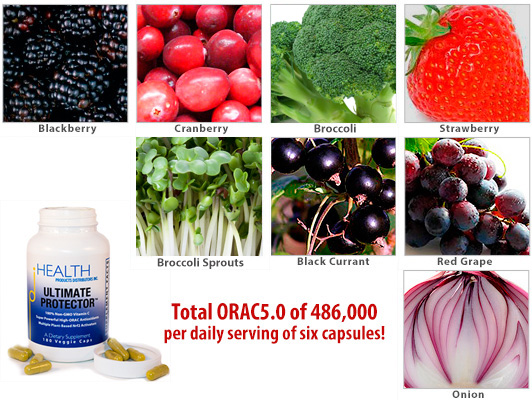
 Ultimate Protector contains broccoli and broccoli sprouts powder, as well as components from 29 different fruits, vegetables, and herbs. Each of these ingredients contain substances that may be considered to be polyphenols, antioxidants, and Nrf2 activators. In this article, I will explore the ingredient “broccoli and broccoli sprouts powder,” which is a component of VitaVeggie from Futureceuticals.
VitaVeggie® is an all-vegetable, high-antioxidant (ORAC) capacity blend rich in phenolics from vegetable concentrates, as well as fully intact vegetable phytochemicals from freeze-dried vegetable powders. VitaVeggie combines the nutrients and antioxidants of broccoli, broccoli sprouts, tomatoes, spinach, kale, carrots, brussels sprouts, and onion.

SULFORAPHANE
In 1992 a team of Johns Hopkins University scientists isolated a cancer-fighting phytochemical in broccoli called glucoraphanin, which is the glucosinolate precursor of sulforaphane.
When chewed, broccoli releases glucoraphanin and myrosinase, an enzyme found in another part of the plant cell, which work together to produce sulforaphane, which in turn activates a transcription factor (Nrf2) in the cell. After activation, Nrf2 then translocates to the nucleus of the cell, where it aligns itself with the antioxidant response element (ARE) in the promoter region of target genes.
The target genes are associated with processes which assist in regulating cellular defenses. Such cytoprotective genes include that for glutathione. Around 200 genes have been well-characterized, and as many as 1700 may be related to this aspect of cellular defense. The 1992 study was followed by the discovery in 1997 that glucoraphanin is found in higher concentrations in three- to four-day-old broccoli sprouts, at least 20 times the concentration of full-grown broccoli.
STUDIES DEMONSTRATING THE BENEFITS OF BROCCOLI AND BROCCOLI SPROUTS
Implications of Cancer Stem Cell Theory for Cancer Chemoprevention
by Natural Dietary Compounds
Abstract
The emergence of cancer stem cell theory has profound implications for cancer chemoprevention and therapy. Cancer stem cells give rise to the tumor bulk through continuous self-renewal and differentiation. Understanding the mechanisms that regulate self-renewal is of greatest importance for discovery of anti-cancer drugs targeting cancer stem cells. Naturally occurring dietary compounds have received increasing attention in cancer chemoprevention. The anti-cancer effects of many dietary components have been reported for both in vitro and in vivo studies. Recently, a number of studies have found that several dietary compounds can directly or indirectly affect cancer stem cell self-renewal pathways. Herein we review the current knowledge of most common natural dietary compounds for their impact on self-renewal pathways and potential effect against cancer stem cells. Three pathways (Wnt/β-catenin, Hedgehog, and Notch) are summarized for their functions in self-renewal of cancer stem cells. The dietary compounds, including curcumin, sulforaphane, soy isoflavone, epigallocatechin-3-gallate, resveratrol, lycopene, piperine, and vitamin D3, are discussed for their direct or indirect effect on these self-renewal pathways. Curcumin and piperine have been demonstrated to target breast cancer stem cells. Sulforaphane has been reported to inhibit pancreatic tumor initiating cells and breast cancer stem cells. These studies provide a basis for preclinical and clinical evaluation of dietary compounds for chemoprevention of cancer stem cells. This may enable us to discover more preventive strategies for cancer management by reducing cancer resistance and recurrence and improving patient survival.
Targeting cancer stem cells with sulforaphane, a dietary component from broccoli and broccoli sprouts.
Abstract
Sulforaphane, a dietary component of broccoli/broccoli sprouts,
inhibits breast cancer stem cells.
Abstract
PURPOSE:
The existence of cancer stem cells (CSCs) in breast cancer has profound implications for cancer prevention. In this study, we evaluated sulforaphane, a natural compound derived from broccoli/broccoli sprouts, for its efficacy to inhibit breast CSCs and its potential mechanism.
EXPERIMENTAL DESIGN:

RESULTS:
Sulforaphane (1-5 micromol/L) decreased aldehyde dehydrogenase-positive cell population by 65% to 80% in human breast cancer cells (P < 0.01) and reduced the size and number of primary mammospheres by 8- to 125-fold and 45% to 75% (P < 0.01), respectively. Daily injection with 50 mg/kg sulforaphane for 2 weeks reduced aldehyde dehydrogenase-positive cells by >50% in nonobese diabetic/severe combined immunodeficient xenograft tumors (P = 0.003). Sulforaphane eliminated breast CSCs in vivo, thereby abrogating tumor growth after the reimplantation of primary tumor cells into the secondary mice (P < 0.01). Western blotting analysis and beta-catenin reporter assay showed that sulforaphane downregulated the Wnt/beta-catenin self-renewal pathway.
CONCLUSIONS:
Sulforaphane inhibits breast CSCs and downregulates the Wnt/beta-catenin self-renewal pathway. These findings support the use of sulforaphane for the chemoprevention of breast cancer stem cells and warrant further clinical evaluation.
Dietary sulforaphane-rich broccoli sprouts reduce colonization and attenuate gastritis in Helicobacter pylori-infected mice and humans.
Abstract
Sulforaphane absorption and excretion following ingestion of a semi-purified broccoli powder rich in glucoraphanin and broccoli sprouts in healthy men.
From: http://www.ncbi.nlm.nih.gov/pubmed/21240766
Nutr Cancer. 2011;63(2):196-201. doi: 10.1080/01635581.2011.523495, Cramer JM, Jeffery EH.
Abstract
Bioavailability of sulforaphane from two broccoli sprout beverages:
Results of a short term, cross-over clinical trial in Qidong, China
Abstract
One of several challenges in design of clinical chemoprevention trials is the selection of the dose, formulation and dose schedule of the intervention agent. Therefore, a cross-over clinical trial was undertaken to compare the bioavailability and tolerability of sulforaphane from two of broccoli sprout-derived beverages: one glucoraphanin-rich (GRR) and the other sulforaphane-rich (SFR). Sulforaphane was generated from glucoraphanin contained in GRR by gut microflora or formed by treatment of GRR with myrosinase from daikon (Raphanus sativus) sprouts to provide SFR. Fifty healthy, eligible participants were requested to refrain from crucifer consumption and randomized into two treatment arms. The study design was as follows: 5-day run-in period, 7-day administration of beverages, 5-day washout period, and 7-day administration of the opposite intervention. Isotope dilution mass spectrometry was used to measure levels of glucoraphanin, sulforaphane and sulforaphane thiol conjugates in urine samples collected daily throughout the study. Bioavailability, as measured by urinary excretion of sulforaphane and its metabolites (in approximately 12 hour collections after dosing), was substantially greater with the SFR (mean = 70%) than with GRR (mean = 5%) beverages. Interindividual variability in excretion was considerably lower with SFR than GRR beverage. Elimination rates were considerably slower with GRR allowing for achievement of steady state dosing as opposed to bolus dosing with SFR. Optimal dosing formulations in future studies should consider blends of sulforaphane and glucoraphanin as SFR and GRR mixtures to achieve peak concentrations for activation of some targets and prolonged inhibition of others implicated in the protective actions of sulforaphane.
SUMMARY
Broccoli–and especially broccoli sprouts with its high content of sulforaphane–contain important polyphenols, antioxidants, and Nrf2 activators that help make Ultimate Protector an outstanding nutritional supplement. Broccoli and broccoli sprouts have been used extensively in nutritional healing protocols for almost 25 years now.
Continued research shows a growing list of health benefits for these nutritional substances, especially relating to Nrf2 activity and ability to provide significant chemoprevention. They add an important vegetable profile to the ingredient mix in Ultimate Protector™.
ADDITIONAL RESOURCES
HPDI BLOG ARTICLES
- Questions & Answers about Ultimate Protector
- The Amazing Healing Potential of Natural Nrf2 Activators
- New Directions For Preventing Free-Radical Damage
- Natural Phytochemical Nrf2 Activators for Chemoprevention
- Ultimate Protector™ Brunswick Labs ORAC5.0™ Test Results
- Description and Comparison of ORAC Tests for Well Known Plant Ingredients and Ultimate Protector™
- Ultimate Protector™: First Impressions
- Preventing Free-Radical Damage Using Ultimate Protector™
- PRO-C™ Super Antioxidant Formula
OTHER RESOURCES
- Ultimate Protector (product page)
- ORAC Database (including food ORAC test results)
